https://www.4dcontact.com/insights/interest-free-loan-late-payment/
4D Contact, Global Debt Recovery and Credit Management Services 1200627
The Interest-Free Loan You Never Agreed To
4D Contact, Global Debt Recovery and Credit Management Services310310
Written by Martin Kirby
Read it in 5 minutes
Martin Kirby
Martin has worked within credit and risk for over 30 years, holding senior positions at organisations such as Business Stream, Kier Group, Adecco UK, and Bupa Healthcare. Martin’s exceptional leadership has earned him industry accolades, including Credit Manager of the Year and Corporate Credit Team of the Year. Martin holds an MBA from INSEAD, providing him with a global perspective on strategic finance, change leadership, and innovation.
Date
8 September 2026
When late payment turns your business into a lender
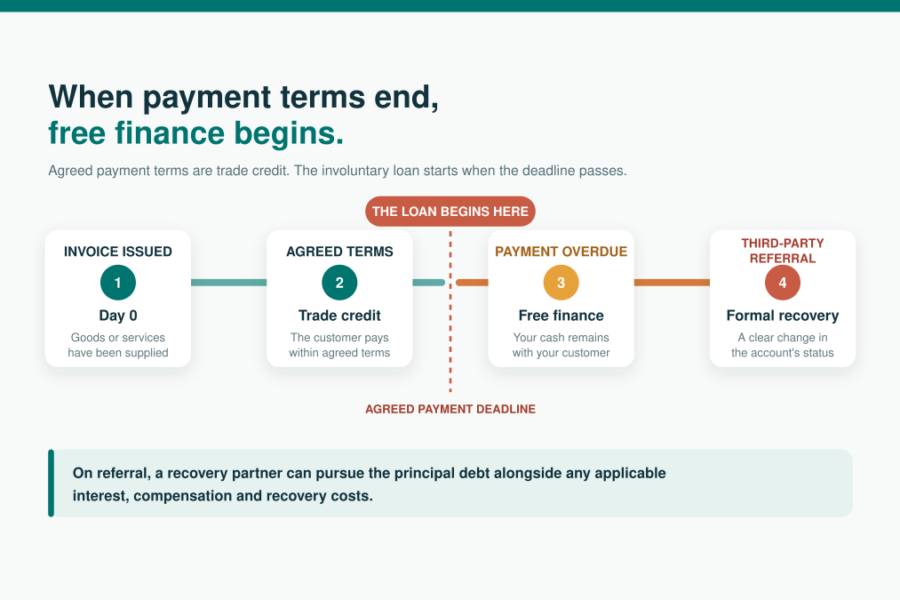
Once an invoice passes its agreed payment date, your customer is no longer simply receiving payment terms. They are using money that belongs to your business – and, in many cases, paying nothing for the privilege. You are financing their working capital, free of charge, for as long as they take to pay.
Not by choice. Not by contract. Simply one overdue invoice at a time.
The scale of this unintentional lending is greater than many businesses realise. The Small Business Commissioner estimates that UK businesses are owed around £26 billion in late payments at any given time. The same research estimates that late payment contributes to approximately 14,000 business closures a year – the equivalent of 38 businesses closing every day.
The right many businesses are reluctant to use
Here’s what makes this particularly frustrating: a remedy already exists – and has done since 1998.
Under the Late Payment of Commercial Debts (Interest) Act, businesses are entitled to charge statutory interest at 8% above the Bank of England base rate, together with fixed compensation and, in some circumstances, reasonable recovery costs. This right can apply even where the contract contains no specific clause allowing interest to be charged.
Yet many businesses are reluctant to use it.
The reason is not necessarily ignorance. It is relationship risk. As anyone in sales and marketing will tell you, winning new customers comes at a price – and they are not always easy to replace. Keeping existing customers trading can therefore be critical to achieving long-term financial targets. This can make a degree of short-term financial forbearance appear a small price to pay for protecting future revenue.
So, businesses quietly absorb the cost as part of maintaining the commercial relationship. Funding their customers’ cashflow while placing increasing pressure on their own.
While an account remains within internal credit control, every collection decision is influenced by the wider commercial relationship. Credit teams may know that interest and compensation can be claimed, but they must balance that right against the priorities of sales teams, account managers and colleagues focused on protecting future revenue.
Third-party referral creates a clear change in the status of the account. It signals that the debt has moved beyond routine payment chasing and now requires formal resolution. The recovery partner can pursue the principal sum alongside any applicable statutory interest, compensation and recovery costs – or use them as part of a commercially sensible negotiation. Crucially, the supplier no longer has to lead that more difficult conversation. Separating the collections process from the day-to-day customer relationship allows the recovery partner to apply appropriate pressure while the supplier maintains some distance from the escalation.
That does not mean abandoning the commercial relationship. Professional recovery should remain proportionate, constructive and focused on securing payment wherever possible. But it removes the expectation that the supplier must continue financing its customer simply because enforcing its rights feels commercially uncomfortable.
The direction of travel is clear
Businesses may currently be reluctant to charge interest on overdue invoices, but the regulatory position is moving firmly towards making late payment carry an unavoidable cost.
The Commercial Payments Bill currently progressing through Parliament proposes to make statutory interest on late commercial debts mandatory and non-waivable. It would also introduce a maximum payment term of 60 days in qualifying contracts between larger customers and smaller suppliers, while giving the Small Business Commissioner stronger powers to investigate poor payment practices and take action against persistent late payers.
The message is clear: late payment is no longer being treated as a private inconvenience for suppliers to tolerate quietly. It is an economic problem that shifts financial pressure from the customer withholding payment to the business that has already delivered the goods or services.
Businesses do not need to wait for legislation to reconsider that imbalance. Treating interest and compensation as a normal part of the recovery process makes it clear that agreed payment terms have a purpose. Using a supplier’s money beyond them should not be cost-free.
The bottom line
Payment terms are a commercial agreement. Continuing to finance a customer after those terms have expired is not.
Yet businesses often tolerate overdue payment because the alternative feels commercially risky. Protecting the customer relationship matters – but it should not mean allowing the customer to protect its own cashflow at the expense of yours. Where pursuing the full amount internally risks placing strain on that relationship, third-party recovery provides another route.
A professional recovery partner can pursue the principal debt alongside any applicable interest, compensation and recovery costs. While keeping the contact approach proportionate and focused on resolution.
Late payment should not be an interest-free loan funded by your business. Agreed payment terms have an end date – and using your money beyond it should have a cost.
If overdue accounts are placing pressure on your cashflow, speak to us about how third-party recovery could strengthen your collections process while protecting valuable customer relationships.

 310
310
310
310