https://www.4dcontact.com/insights/seasonality-in-debt-collection-why-credit-managers-shouldnt-judge-performance-by-q3-alone/
4D Contact, Global Debt Recovery and Credit Management Services 1200627
Seasonality in Debt Collection: Why Credit Managers Shouldn’t Judge Performance by Q3 Alone
4D Contact, Global Debt Recovery and Credit Management Services310310
Written by Martin Kirby
Read it in 5 minutes
Martin Kirby
Martin has worked within credit and risk for over 30 years, holding senior positions at organisations such as Business Stream, Kier Group, Adecco UK, and Bupa Healthcare. Martin’s exceptional leadership has earned him industry accolades, including Credit Manager of the Year and Corporate Credit Team of the Year. Martin holds an MBA from INSEAD, providing him with a global perspective on strategic finance, change leadership, and innovation.
Understanding the Summer Slowdown in Global Collections
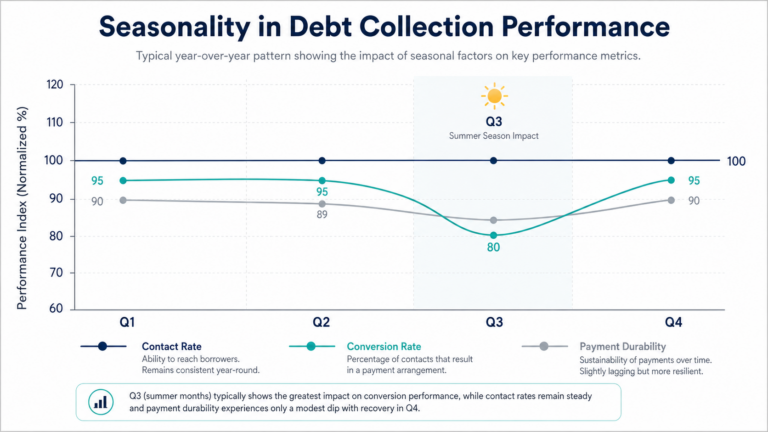
Every year, as Q3 unfolds, a familiar pattern emerges across global credit and collections operations. Contact rates remain stable, yet conversion metrics begin to soften. Payment arrangements appear less reliable, and recovery curves flatten.
For many Credit Directors and Credit Managers, the reaction is to question the performance of their debt collection agency (DCA). In some cases, this leads to premature supplier reviews and potentially termination decisions.
However, this response is often based on a flawed diagnosis.
What appears to be underperformance is, in most cases, a predictable and recurring phenomenon: seasonality in debt collection.
Understanding this distinction is critical. Misinterpreting seasonal variation as operational failure can lead to decisions that disrupt long-standing partnerships, reduce recovery efficiency, and ultimately increase credit risk exposure.
What Really Drives Q3 Collection Performance?
Seasonality in accounts receivable and B2B credit control is not about willingness to pay -it’s about capacity and context.
During the summer months, several global factors influence debtor behavior:
1. Reduced Availability
Holidays, travel, and flexible working schedules disrupt normal communication patterns. Decision-makers are harder to reach, and response times lengthen.
2. Lower Short-Term Liquidity
Seasonal expenses – such as travel, childcare, and mid-year costs -impact cash flow. In both consumer and commercial segments, in multiple sectors, liquidity becomes tighter.
3. Deferred Financial Decision-Making
Financial commitments are often postponed rather than declined. Debtors may engage in conversations but delay firm commitments until routines stabilize.
4. Fragmented Operational Routines
For businesses, especially SMEs, summer can mean reduced staffing, slower approvals, and delayed payment processing cycles.
The result? Engagement remains steady, but conversion becomes less immediate and less predictable.
Why Traditional KPIs Can Mislead in Q3
Many credit teams rely heavily on performance comparisons between quarters -particularly benchmarking Q3 against Q1 or Q4. This approach can create misleading conclusions.
Metrics That Distort Reality:
Raw conversion rates
Short-term cash collection spikes
Immediate payment ratios
These indicators often decline in Q3, not due to poor debt collection performance, but because of seasonal behavioral shifts.
Metrics That Matter More:
To accurately assess your DCA during seasonal periods, focus on:
Payment Durability: Are arrangements being honored over time?
Arrangement Quality: Are payment plans realistic given current debtor conditions?
Rework Rates: How often do cases need to be reopened or renegotiated?
Engagement Consistency: Is communication being maintained despite lower immediacy?
These metrics provide a far more reliable view of credit risk management effectiveness during fluctuating periods.
How High-Performing DCAs Adapt to Seasonality
Not all debt collection agencies respond to seasonality in the same way. The difference between average and high-performing partners lies in adaptability.
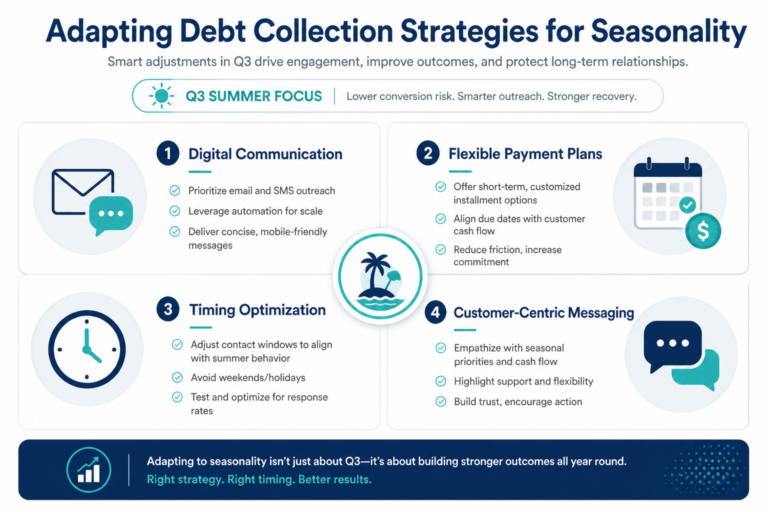
Strategic Adjustments in Q3:
1. Channel Optimization
Leading agencies shift toward asynchronous digital communication – email, SMS, and self-service portals – allowing debtors to respond on their own time.
2. Messaging Reframing
Instead of urgency-driven language, messaging focuses on:
Flexibility
Support
Sustainable repayment options
This approach aligns with the debtor’s seasonal mindset and increases long-term recovery rates.
3. Timing Intelligence
Contact strategies are adjusted to reflect altered daily routines, increasing the likelihood of meaningful engagement.
4. Realistic Payment Structuring
Experienced agencies prioritize achievable arrangements over aggressive short-term recovery targets, reducing default rates later in the cycle.
In short, recovery does not stop -it evolves.
The Risk of Misinterpreting Seasonal Trends
When organizations fail to recognize seasonality as a structural factor in international collections, they often take reactive measures that create long-term inefficiencies.
Common Missteps:
Replacing a DCA based on short-term Q3 performance
Imposing unrealistic collection targets
Increasing pressure tactics that damage customer relationships
Overcorrecting strategies that were effective in other quarters
These actions can lead to:
Lower overall recovery across the year
Increased operational costs
Damaged brand perception in key markets
Reduced debtor cooperation in future cycles
In global credit management, consistency and strategic alignment outperform reactive decision-making.
Seasonality as a Strategic Planning Variable
The most effective credit operations treat seasonality not as a disruption, but as a predictable planning variable within their accounts receivable strategy.
This means:
Forecasting seasonal fluctuations in cash flow and recovery rates
Aligning KPIs with quarterly realities
Collaborating with DCAs on adaptive strategies
Adjusting internal expectations and reporting frameworks
By embedding seasonality into your B2B credit control model, you create a more resilient and accurate performance ecosystem.
A Smarter Approach to Evaluating Your Collections Partner
If your current agency is delivering the same strategy in July as in January, that’s a signal worth examining.
The question isn’t whether performance dips -it’s how your partner responds to the dip.
A capable DCA should demonstrate:
Awareness of seasonal behavioral patterns
Proactive strategy adjustments
Transparent performance reporting aligned with seasonal KPIs
A focus on sustainable recovery, not short-term optics
Conclusion: Don’t Confuse Seasonality with Underperformance
Q3 challenges are not a failure of your debt collection strategy – they are a reflection of the environment in which it operates. For Credit Directors and Credit Managers, the priority should be to distinguish between true underperformance and seasonal variation. The cost of getting this wrong is not just operational – it’s strategic.
At 4D Contact, seasonality is built into the approach. Strategies are adapted, not improvised. Performance is measured with context, not assumptions. Because in global credit risk management, success isn’t about reacting to patterns – it’s about planning for them.
If your collections strategy doesn’t evolve with the calendar, it may be time to reconsider how it’s built.
Is your business looking to improve recovery rates?
4D Contact provide a comprehensive suite of global outsourced credit-control and debt recovery services for businesses looking to improve cash collection and build resilience and financial stability:
No-win, no-fee.
No onboarding and administration fees.
Up and running in days.
Contact us now at sales@4dcontact.com or +44 (0)20 3773 7854

 310
310
310
310

![[TOFU offer] eBook – A C-Suite executive’s guide to Delivering successful order-to-cash transformation](https://www.4dcontact.com/wp-content/uploads/2019/08/img-ebook-preview-order-cash-transformation.png)