https://www.4dcontact.com/insights/uk-late-payments-reform-2025-are-you-ready/
4D Contact, Global Debt Recovery and Credit Management Services 1200627
UK Late Payment Reform
4D Contact, Global Debt Recovery and Credit Management Services310310
Written by Martin Kirby
Read it in 5 minutes
Martin Kirby
Written by Martin Kirby. Martin has worked within credit and risk for over 30 years, holding senior positions at organisations such as Business Stream, Kier Group, Adecco UK, and Bupa Healthcare. Martin’s exceptional leadership has earned him industry accolades, including Credit Manager of the Year and Corporate Credit Team of the Year. Martin holds an MBA from INSEAD, providing him with a global perspective on strategic finance, change leadership, and innovation.
Date
23 October 2025
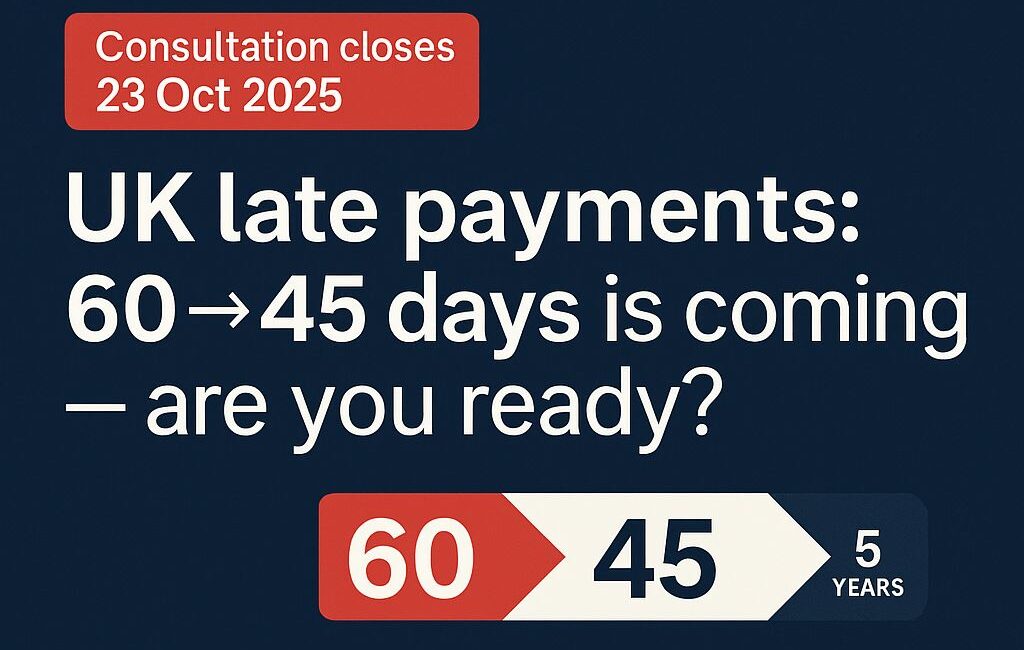
60 → 45 day payment terms is coming – is your business ready?
For years, UK businesses have struggled with the knock-on effects of late payments. The government estimates that late payments cost the UK economy £11 billion annually, affecting over 1.5 million businesses, and contributing to roughly 38 business failures per day. As the government’s “Late Payments: Tackling Poor Payment Practices” consultation draws to a close on 23 October 2025, it’s clear that what’s emerging is one of the most significant UK late payment reforms in a generation – and that businesses need to start preparing now.
Hard cap on payment terms: B2B contracts will be limited to 60 days, with a glide path toward 45 days within five years.
30-day dispute deadline: Businesses will have 30 days to raise any invoice disputes — after that, payment must be made on time.
Mandatory statutory interest: Late payments will automatically accrue interest at Bank Rate + 8%, with no discretion to waive it.
Enhanced transparency: Companies will be required to report statutory interest owed and paid, making the true cost of lateness visible to all stakeholders.
At least 95% of invoices paid within 60 days (or 90% with a credible action plan).
This will be assessed at the selection stage, meaning poor payment performance could disqualify bids before they’re even reviewed.
What UK Late Payment Reform Means for Finance & Procurement Teams
The reforms are more than just compliance — they’ll reshape financial operations across the UK. Here’s what to expect:
1. Days Payable Outstanding Will Compress: With a hard 60-day cap — and 45 days on the horizon — cash will flow out earlier. That means re-forecasting liquidity, updating working capital models, and revisiting covenant headroom now, not later.
2. Disputes Will Be on the Clock: A new 30-day dispute deadline means delays won’t buy time. If you don’t raise a genuine dispute within 30 days, payment must be made — and statutory interest starts accruing the day after the due date. This makes clear SLAs and invoice verification workflows essential.
3. The Cost of Lateness Goes Public: With mandatory interest and public reporting, late payments will no longer stay in the shadows. Lenders, investors and even the media will have visibility — increasing reputational and financial pressure to comply.
4. Board-Level Oversight Will Rise: Audit committees will need to scrutinise payment practices as part of governance. The SBC could be granted assurance and spot-check powers, with penalties for firms that consistently pay late (a potential 25% late-payment trigger is under discussion).
5. Reporting Will Get Tougher:Updated Duty to Report guidance (Sept 2025) introduces more granular metrics — including the value of invoices paid late, percentage disputed, and construction retentions. You’ll need to align definitions and strengthen internal controls.
Complex commercial structures will come under closer scrutiny. This includes:
Extended payment terms through buying groups
Quarterly rebates or marketing allowances
Retrospective credits that distort “days to pay” data
Until final guidance is issued, the safest approach is to:
Measure settlement on the actual cash or clearing date, and
Treat rebates and credits separately from invoice payments.
A 3-Step Action Plan to Start This Week
While not every proposal may become law, the direction of travel is unmistakable. With less than a year before the first major procurement rules take effect, now’s the time to act.
1. Map & Model
Audit all supplier terms and simulate how the 60-day cap (and 45-day future limit) will impact working capital. Identify contracts that exceed the threshold and begin renegotiations.
2. Codify Disputes
Implement a 30-day dispute process. Configure your ERP to timestamp dispute activity and auto-accrue statutory interest after due dates.
3. Shine a Light
Build a Payment Practices dashboard to track invoice-level metrics — days to pay, disputes, and interest owed/paid — and brief your audit committee regularly.
Final Thought: Compliance as a Competitive Advantage
The new framework outlined in the UK late payment reform will challenge traditional payment practices — but it’s also an opportunity. Businesses that act early can turn compliance into a competitive differentiator, strengthening supplier relationships, enhancing credibility with investors, and improving eligibility for government contracts.
Is your business looking to improve recovery rates?
4D Contact provide a comprehensive suite of global outsourced credit-control and debt recovery services for businesses looking to improve cash collection and build resilience and financial stability:
No-win, no-fee.
No onboarding and administration fees.
Up and running in days.
Contact us now at sales@4dcontact.com or +44 (0)20 3773 7854
 310
310
310
310


![[TOFU offer] eBook – A C-Suite executive’s guide to Delivering successful order-to-cash transformation](https://www.4dcontact.com/wp-content/uploads/2019/08/img-ebook-preview-order-cash-transformation.png)