https://www.4dcontact.com/insights/why-dso-is-a-diagnostic-not-a-target/
4D Contact, Global Debt Recovery and Credit Management Services 1200627
Why DSO is a diagnostic, not a target.
4D Contact, Global Debt Recovery and Credit Management Services310310
Written by Martin Kirby
Read it in 5 minutes
Martin Kirby
Martin has worked within credit and risk for over 30 years, holding senior positions at organisations such as Business Stream, Kier Group, Adecco UK, and Bupa Healthcare. Martin’s exceptional leadership has earned him industry accolades, including Credit Manager of the Year and Corporate Credit Team of the Year. Martin holds an MBA from INSEAD, providing him with a global perspective on strategic finance, change leadership, and innovation.
Date
3 August 2026
A look at the four real drivers of rising DSO and some practical steps to improve working capital and cash flow.
When day-sales-outstanding starts to climb, the instinct is almost always the same. Lean on the receivables team. Chase harder. Send more reminders. Tighten the dunning cycle.
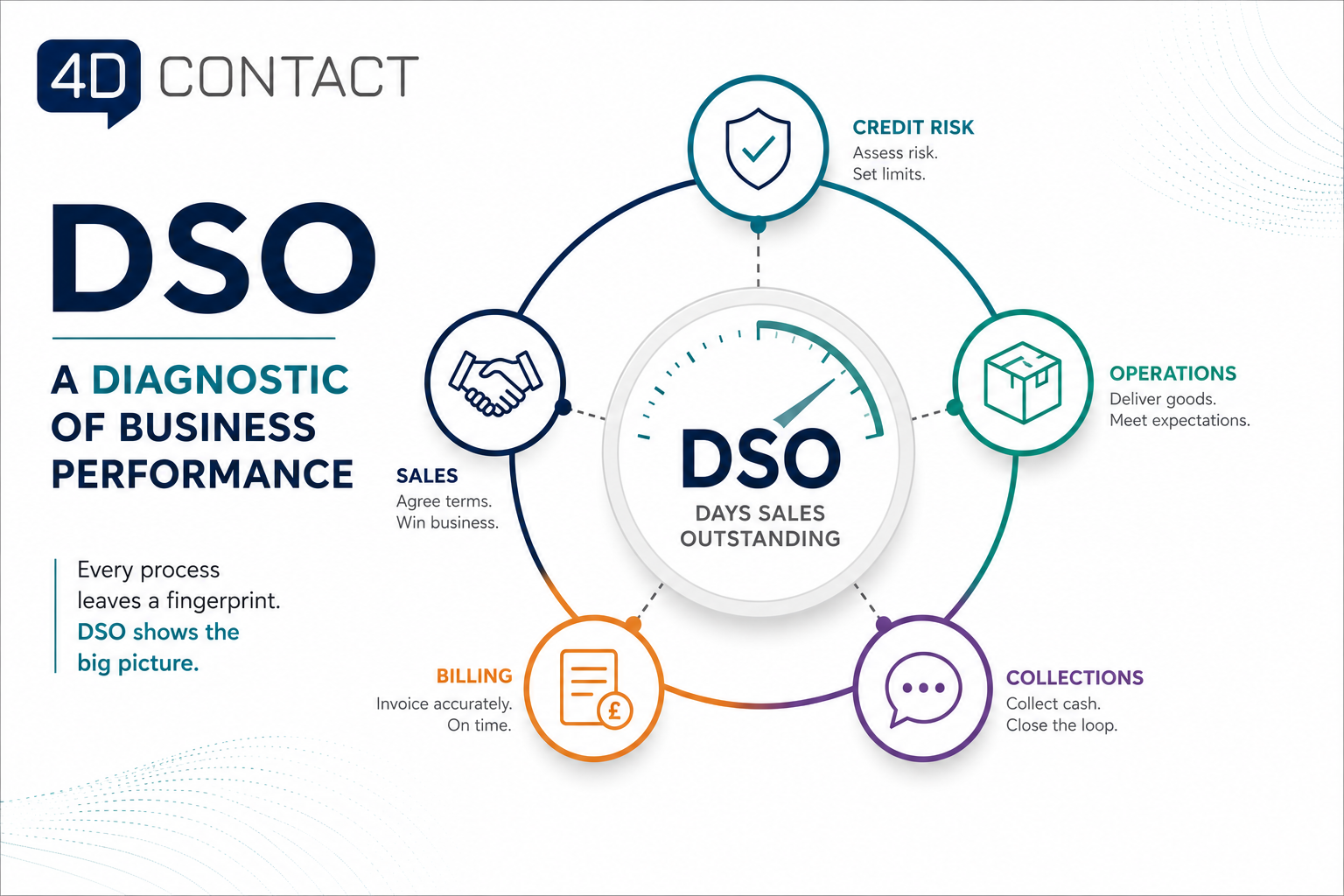
Sometimes that buys you a day or two at the margin. Mostly it treats the temperature and ignores the infection. DSO is a symptom. The cause almost always sits upstream of the people sending the statements—and no amount of chasing reaches it.
That matters because slower collections rarely occur in isolation. Atradius’ latest Payment Practices Barometer found that businesses across Western Europe are grappling with longer DSO alongside rising bad debts and increasing working capital pressure, with customer liquidity issues cited as the primary cause of late payment.
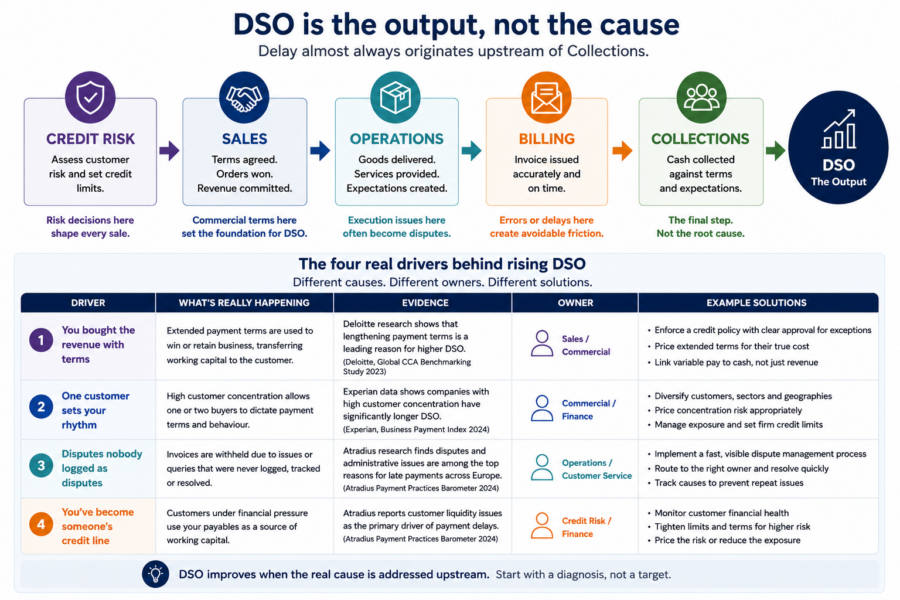
Treat the number as a diagnostic instead of a target, and the deterioration usually decomposes into four drivers. Each is a different problem. Each has a different owner. And not one of them lives in the collections team.
1. Revenue was bought with terms.
The most expensive cause hides inside the sales process. To land the quarter, the deal gets discounted on price, and then discounted again on payment terms. Net-30 quietly becomes net-60 or net-90. The revenue still books at full value. The cash turns up a quarter later. And the cost of carrying it never lands on the person who gave the terms away.
The cost of those longer terms is real, even if it rarely appears anywhere on the sales forecast. The UK’s Late Payment of Commercial Debts legislation allows suppliers to charge statutory interest at 8% above the Bank of England base rate on qualifying overdue commercial invoices. Few businesses routinely exercise that right with valued customers, but it provides a useful benchmark for the hidden cost of extending trade credit. Every additional day financed without being priced is working capital transferred from your balance sheet to someone else’s.
2. One customer sets your rhythm
When one or two buyers account for a significant share of your ledger, they begin to dictate your cash conversion cycle. Their payment habits become your payment habits.
They pay on their cycle. They stretch when their own liquidity tightens. They negotiate exceptions because they know they’re strategically important. You absorb the delay because challenging it feels commercially risky.
This is structural rather than behavioural, and no amount of chasing changes it. It is a concentration risk.
The answer isn’t simply collecting harder. It’s diversifying the customer portfolio over time, pricing extended payment terms appropriately, and recognising that a customer large enough to influence your DSO is also large enough to create a material credit exposure if their financial position deteriorates.
3. Disputes nobody logged as disputes
A surprising proportion of overdue invoices aren’t genuinely overdue in the customer’s mind—they’re disputed. Whether it’s a pricing discrepancy, missing proof of delivery, damaged goods or an unanswered query, the invoice remains unpaid because the customer is waiting for a resolution rather than a reminder.
The invoice sits unpaid because the customer is unhappy – but nobody logged a dispute, so it surfaces as a collections failure when it’s really a service failure wearing the wrong label. You can’t dun your way out of it; the customer is waiting for an answer, not a reminder. The fix is a fast, visible dispute loop that catches these early, routes them to whoever can actually resolve them, and stops them ageing in silence on the ledger. Every day one of these sits unresolved is a day of DSO booked against the wrong team.
4. You’re financing your customer’s cashflow
When a customer’s own bank line is tight, the cheapest working capital available to them is sitting in your payables. They stretch you because you let them, and because you don’t charge for it. Free money is hard to give back.
Rising DSO concentrated in financially stressed accounts isn’t simply an administrative lag. It’s a diagnostic warning of counterparty risk—often the earliest one you’ll receive. Long before a customer defaults, they frequently begin preserving cash by paying suppliers later.
The response isn’t simply to chase harder. It should be to strengthen credit monitoring, review credit limits, reassess payment terms and price risk appropriately before temporary delays become permanent losses. By the time an invoice becomes a bad debt, the warning signs have often been visible for months.As Dun & Bradstreet notes:
“Slow payments can affect business credit scores and ratings such as the D&B PAYDEX® Score. Continual slow or late payments could indicate to vendors, suppliers, or lenders that a company may not pay them on time and in terms—or even at all.” Dun and Bradstreet Resources “How to Combat Slow Payments”
That’s why finance leaders shouldn’t view rising DSO simply as a collections issue. When payment performance deteriorates within a group of customers, DSO becomes an early warning signal of changing credit quality. The smartest organisations use that signal to review exposure, tighten controls and act before today’s slow payer becomes tomorrow’s write-off.
Conclusion: Diagnose before you set a target
“Reduce DSO by five days” sounds like a sensible objective. In reality, it assumes there is only one underlying cause.
There rarely is.
The four drivers above belong to four different owners—Sales, Commercial, Operations and Credit Risk. Pulling the collections lever won’t fix pricing decisions, customer concentration, operational disputes or deteriorating counterparty health.
High-performing finance teams therefore ask a different question.
Not “How do we reduce DSO?”
But “What is our DSO trying to tell us?”
Viewed this way, DSO becomes more than a collections metric. It becomes a measure of the quality of your revenue, the discipline of your commercial decisions and the resilience of your working capital.
The organisations that consistently improve cash flow don’t simply chase invoices harder. They identify the real cause of delay and fix it where it begins—not where it eventually appears on the aged debtor report.
 310
310
310
310